Sworn Craft: How Europe's Guilds Ran the Economy, 1100–1800 (E-book, PDF)
Sworn Craft: How Europe's Guilds Ran the Economy, 1100–1800 (E-book, PDF)
Couldn't load pickup availability
For seven hundred years, most of what Europeans wore, ate off, built with and were buried in was made by someone who belonged to a guild. It is an extraordinary fact about an institution almost nobody can define without arguing — and this dossier takes that argument as its subject rather than its obstacle.
Ten chapters, roughly 6,000 words, written as one continuous argument rather than assembled from articles:
- What a guild actually was — the oath, and the five things bolted onto it
- The written rule — charters, statutes, and why a guild privilege was almost always bought
- Merchants are a different animal — why collapsing merchant and craft guilds ruins the question
- Becoming a master — apprentice, journeyman, and the two levers that stopped most people finishing
- The secret as capital — Lucca's silk, Murano's glass, and the horizon of secrecy
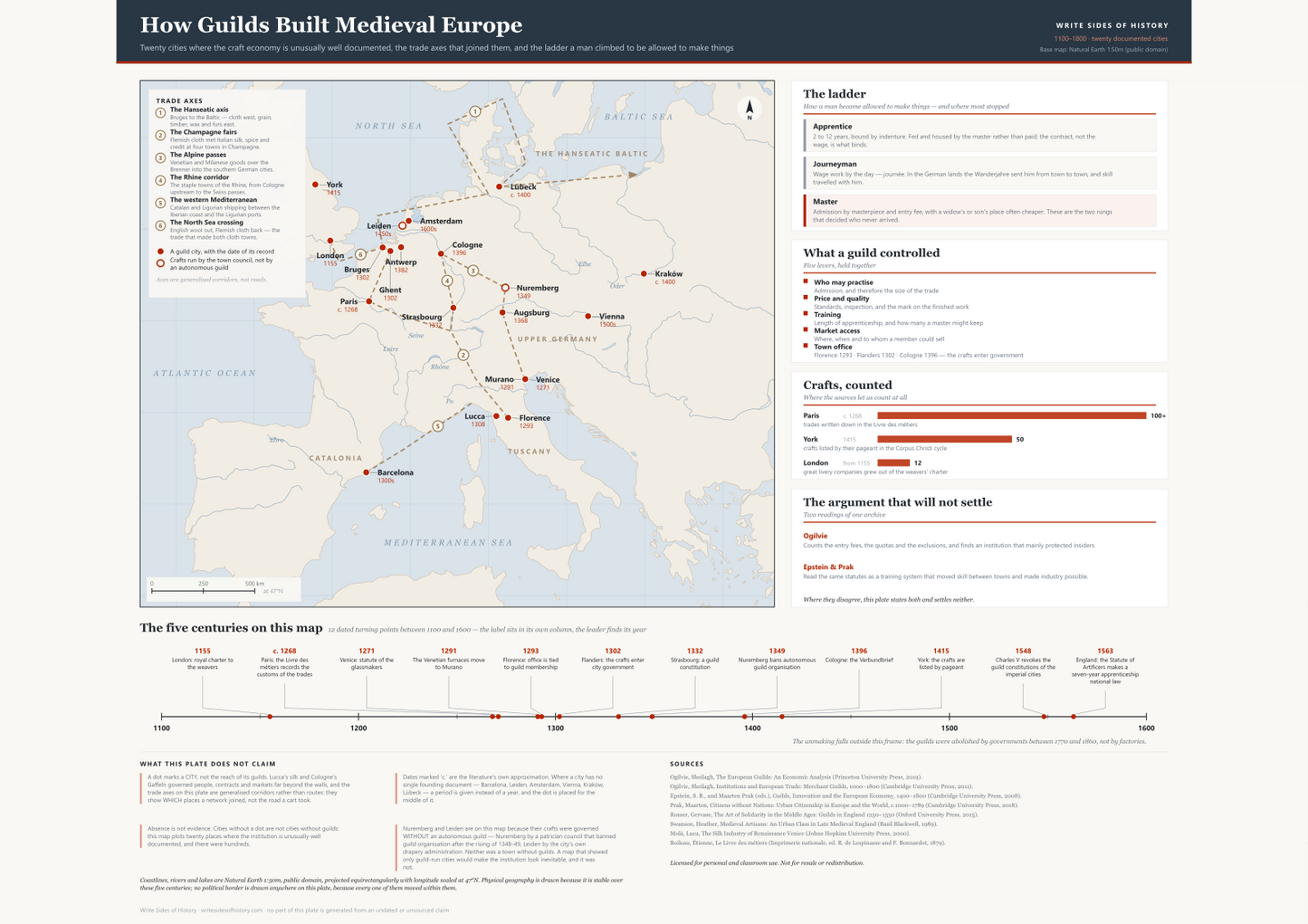
- Guilds in government — Florence 1293, Flanders 1302, Cologne 1396
- The cities that said no — Nuremberg banned them; Leiden never had them; both thrived
- The competition outside the walls — how putting-out took the countryside
- The two-hundred-year argument — Ogilvie against Epstein and Prak, and why it will not settle
- The unmaking, 1770–1860 — abolished by governments, not by factories
What you receive — three files
- A4 PDF and US Letter PDF, each with the map plate at the back
- A mobile edition laid out on a page sized for a phone screen, so a line stays a line
- Chronology of eighteen dated milestones, an eighteen-term glossary, a full bibliography, and a note on evidence explaining why nothing in the book is quoted
What it does not do
It does not tell you whether guilds were good or bad, because the evidence does not settle that and pretending otherwise would be the easy lie. Where historians disagree, both positions are stated and attributed. Where a date is approximate it says so. No primary source is quoted, because translating medieval French, Italian and Middle Low German is itself an argument about meaning — provisions are summarised, and the edition is named.
How you receive it
Your download is ready the moment your payment goes through: the link arrives by e-mail and also appears on your order confirmation page. There is no limit on how often you download it, and the files are yours to keep.
Delivery and licence
A digital download. Nothing is shipped and no delivery address is asked for. Licensed for personal and classroom use; not for resale or redistribution.
The rest of the collection
All four are built from the same twenty cities and the same eighteen dated milestones, so they agree with each other line for line.
- Guild Cities of Europe — Map & Timeline — €9,95
- Guilds and the Craft Economy — Classroom Pack, ages 14–18 — €19,95
- The Guilds Collection — all three together — €29,95
The free articles this dossier draws its examples from are at writesidesofhistory.com, and they stay free.
Share