How Medieval Europe Learned to Move Money, 1150–1500 — Map & Timeline
How Medieval Europe Learned to Move Money, 1150–1500 — Map & Timeline
Kan beschikbaarheid voor afhalen niet laden
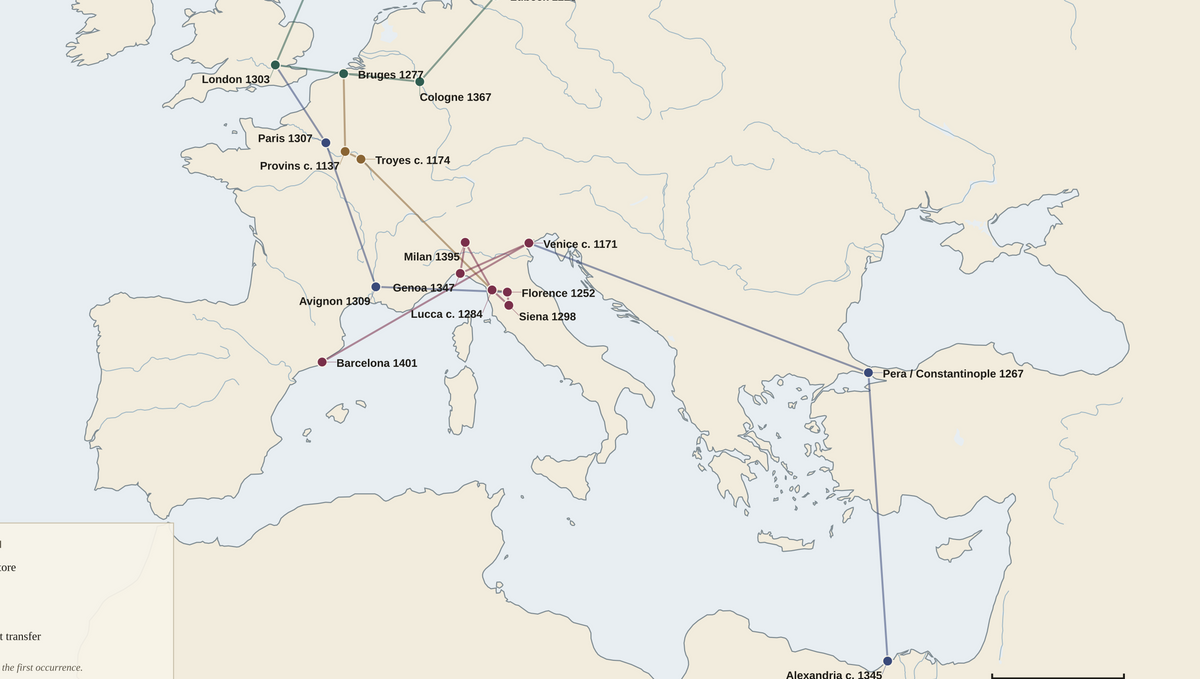
How Medieval Europe Learned to Move Money is a large-format plate from Writesides of History, drawn from records rather than impressions. It maps twenty places where credit, coin and clearing are documented between 1150 and 1500, the five networks that joined them, and the instruments that made distance payable.
The map is built on a real cartographic base — Natural Earth 1:50m coastlines and rivers, public domain — and every dot marks a place where an institution is documented, with its date. From Bergen and Novgorod at the northern edge of the Hanseatic Kontor system, through Lübeck, Danzig, Cologne, Bruges and London, down to the Champagne fairs at Troyes and Provins, and on to the Italian banking houses of Florence, Siena, Venice, Genoa, Lucca and Milan, the papal transfer routes through Avignon, and the Levant terminals at Pera and Alexandria.
Five infographic panels explain the machinery: the bill of exchange, the Kontor, why double-entry bookkeeping mattered, what happened when a bank failed, and why the Champagne fairs stopped mattering. A nineteen-entry chronology runs from the first documented instruments to the printing of Pacioli's Summa in 1494.
The plate states what it cannot show. A printed panel lists five explicit uncertainties: every date is that of the earliest surviving record and not of first occurrence; a dot marks documentation, not the reach of a network; the lines are generalised ties and not courier routes; the decline of the Champagne fairs has no single date and historians disagree about the cause; and no volumes are drawn, because the surviving figures are too partial to compare one city with another without inventing precision.
Sources are named on the plate and include Peter Spufford's Money and its Use in Medieval Europe and Power and Profit, Raymond de Roover on the Medici bank, Robert Lopez on the commercial revolution, Philippe Dollinger on the German Hansa, and Richard Goldthwaite on Renaissance Florence, alongside two primary texts: Leonardo of Pisa's Liber Abaci (1202) and Pacioli's Summa (1494).
Four files, one download: a print-ready A2 landscape vector PDF, an A4 landscape PDF for a classroom printer, a scalable SVG, and a 2400-pixel PNG. The PDF text is real text, so it stays searchable and selectable.
Format: vector PDF (A2 and A4), SVG, PNG · Coverage: 20 places, 5 networks, 19 dated entries
Share